

Your Deck Isn’t the Presentation. You Are.
Think back to the first time you were asked to present at work.
What did you do? You almost certainly opened a computer, launched PowerPoint, and started building slides. No one told you to do that. No one needed to. The habit was ambient, carried by everyone around you, modeled by the leaders above you, rewarded by the culture you’d inherited.
You prepared your materials. And somewhere in that preparation, without ever consciously deciding it, you began to conflate the materials with the message. The deck became the presentation. The slides became the substance. And you became, at best, the person narrating them.
This is the habit no one taught you to question.
I once worked with a large, international construction company that had been responding to major RFPs the same way for years: with a sprawling 96-slide deck. Credentials, case studies, differentiators, project plans—all there. Nothing missing.
But in the room, something was always off. The work didn’t feel as big as it actually was. The audience wasn’t invited to feel the firm’s capacity. They were asked to scan it. Pixel by pixel. Slide by slide. The ideas were real. The conviction was real. But the medium was flattening everything.
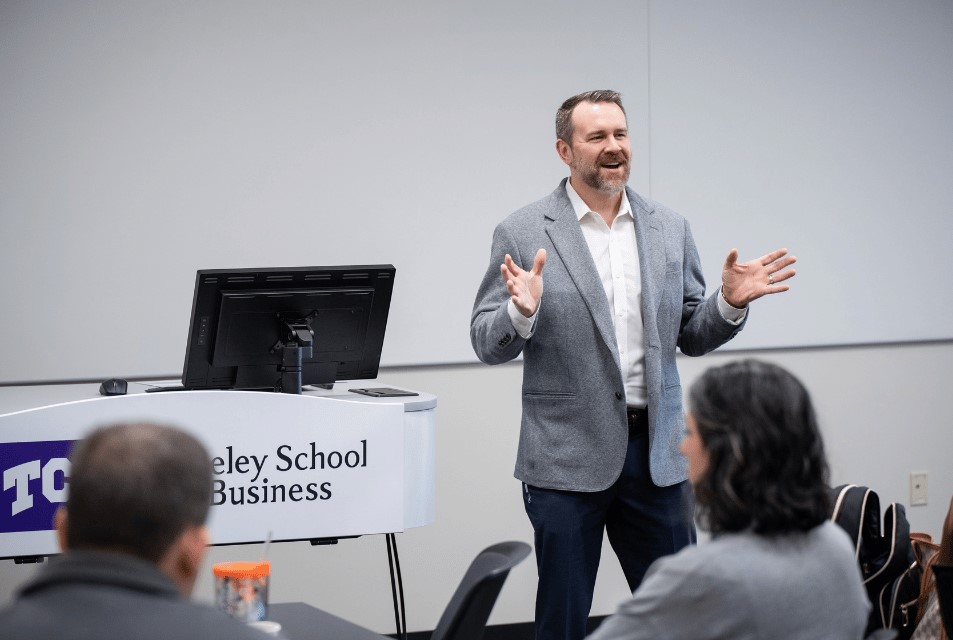 After working through The Campfire Method together, the firm made a choice that felt
radical at the time. They cut the deck to 14 slides. Then they brought their proof
to life—not on a screen, but physically in the room. Poster boards lined the walls,
each showcasing a case study at human scale. People stood up. They walked the room.
They saw the work with their eyes and felt the implications with their minds.
Rehearsals shifted too. Instead of drilling slide transitions, presenters focused on how they embodied the story. The artifacts became aids, not crutches.
The result? Their win rate improved. Not because they got better at formatting slides, but because they got better at delivering meaning.
A deck is a vehicle for information. Your idea needs a vehicle for meaning. Those are not the same thing.
Selling a physical product is straightforward by comparison. Money changes hands. The buyer can inspect it, test it, return it. Selling an idea is different. An idea lives entirely in language, energy, and belief. It asks your audience to part with two resources more precious than money: their time and their attention.
When you step away from a deck, you accept something most presenters try to avoid: responsibility. You become the medium for your idea. Every pause, every expression, every word choice carries weight. There’s no place to hide. No place to deflect.
That sounds terrifying. It’s actually liberating.
Because presence isn’t personality. It’s preparation meeting intention. The leaders who move rooms aren’t always the most charismatic people in them. They’re the most prepared. They’ve done the work of knowing what they believe, who’s listening, and how they want to show up. That decision is available to every one of us. Most of us just haven’t made it yet.
Consider the word “present” for a moment.
The “present” (noun) is another word for “now.” To be “present” (adjective) is to exist in that very same now. To “present” (verb) is to make something exist to others. And a “present” (noun) is a gift.
The problem with most presentations? The people giving them aren’t very… present.
We’re so busy clicking through slides, managing animations, reading bullet points off the screen, that we’ve stopped actually being in the room with the people we’re trying to move. Business development consultant Blair Enns put it perfectly: “You can present to people or you can be present to them. You cannot do both.”
Studies show emotional connection peaks when 60–70% of eye contact is maintained between speaker and listener. When you’re locked into advancing slides, you’re not connecting with your audience. You become a passive medium between a screen and a set of increasingly distracted humans.
I’m not saying throw away your slides. Decks aren’t evil. They’re useful for documentation, for leave-behinds, for reference material that lives after the meeting.
But decks are terrible at creating conviction. If your role as a leader is to create belief and drive action, then the question worth asking is: to what degree have you been outsourcing leadership to a template?
Be honest. When was the last time a slide deck truly moved you? Did it make you behave differently the next day? Did it change how you felt? Decks excel at organizing information. But meaning isn’t information. Meaning lives in interpretation, in emotional clarity, in a journey the audience takes with you.
The best medium for your idea isn’t a deck. It’s you.
Here’s what changes when you accept that: You stop spending four hours picking fonts and start spending that time understanding your audience. You stop rehearsing slide transitions and start rehearsing how you’ll tell the story when the projector dies. You stop asking “Did I cover everything?” and start asking “Will they remember anything?”
You start showing up—not as a narrator of someone's template, but as a leader who carries meaning in their voice, their presence, and their conviction.
Your audience didn’t come for the slides. They came for you. Give them a reason to stay.
-hold for writer information/details...