
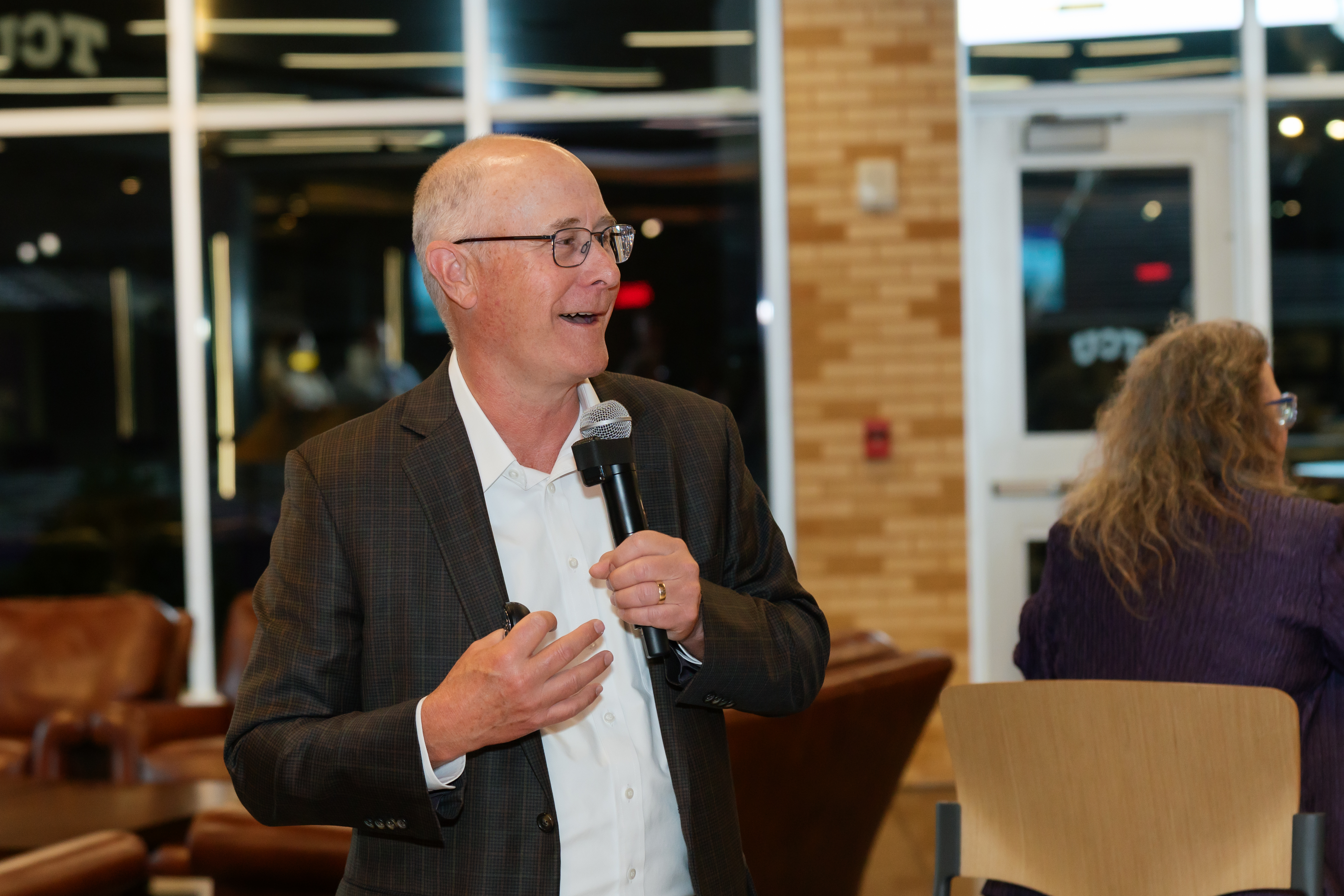
Big 12 Faculty Honor Recognizes Morgan Swink's Impact on Supply Chain Research
For more than three decades, Morgan Swink has studied a field that rarely stands still. Global disruptions, emerging technologies and changing business practices have continually reshaped supply chains, creating new questions for researchers and business leaders alike.
Swink was recently named TCU’s representative for the Big 12 Conference’s 2026-27 Faculty of the Year Award, recognizing work that has consistently connected academic inquiry with the challenges facing business and industry. He is the Eunice and James L. West Chair in Supply Chain Management at the TCU Neeley School of Business and serves as executive director of Neeley’s Center for Supply Chain Innovation.
 “I’m highly honored that the people making this decision would choose to recognize
my work in this way,” Swink said. “It’s great to be appreciated, and I’m happy for
the visibility this brings to my research and that of my colleagues, as well as to
TCU as a leading research institution.”
“I’m highly honored that the people making this decision would choose to recognize
my work in this way,” Swink said. “It’s great to be appreciated, and I’m happy for
the visibility this brings to my research and that of my colleagues, as well as to
TCU as a leading research institution.”
Now in its third year, the award recognizes one faculty member from each of the Big 12’s 16 member institutions for excellence in innovation and research. Honorees represent disciplines across the conference, showcasing the breadth of research and educational opportunities available to students.
Swink was recognized for work that spans more than 100 articles, editorials and book chapters in operations and supply chain management. He is also the former editor-in-chief of the Journal of Operations Management, one of the field's premier academic publications.
"I feel very fortunate to have been a supply chain operations researcher during this time," Swink said. "In the last 30 years, we have seen major global shifts, disruptions of all kinds and technological advances that have made being a researcher a lot of fun, with many, many interesting questions to examine."
Connecting Research and Practice
That drive toward relevance has shaped how Swink approaches his work. His research
often bridges academic theory and real-world business challenges, including a recent study through the Center for Supply Chain Innovation examining American Airlines' economic impact on North Texas.
"Business schools are professional in the sense that they should be developing ideas and techniques that apply directly to current practice, or at least near-term future practice," Swink said. "I've been a member of a small group within our research field that takes a very applied and pragmatic approach to the research and questions that we address. To me, impact is the top priority for any research project."
Research Rooted in the Classroom
Much of Swink's teaching has centered on graduate students, a dynamic he said has
directly shaped his research agenda.
"This has created lots of opportunities for very fruitful dialogues between myself and my students," Swink said. "Many of the research questions that I've decided to pursue came from those discussions in the classroom. It also gives me a chance to get feedback from some pretty smart people. In addition, I've had at least one graduate student each year decide to pursue a PhD after working with me on a research project."
Looking ahead, Swink pointed to innovation and resilience as the questions most worth business leaders' attention. His research has focused on how firms drive innovation internally and with suppliers and partners, as well as how organizations build supply chains that can withstand disruption.
"I continue to believe that innovation, including the adoption and leverage of rapidly advancing technologies, is a super important area of focus for most businesses," Swink said. "In the last five years or so, the idea of building resilient supply chains, that are responsive or robust in dealing with unforeseen disruptions, has also been a critical capability for organizations and an important part of my research."
He credits early mentors with teaching him how to conduct research and write persuasively, along with years of collaboration with fellow academics and industry practitioners across research teams.
Among the accomplishments Swink is most proud of are his contributions through publications and journal leadership to advancing more practically applied theory. He also points to research in strategy and project management that has drawn wide attention.
He remains especially interested in how firms can plan for, adopt and successfully implement emerging technologies, including artificial intelligence.
“AI is one example, but there are many other types of technologies that are also rapidly changing supply chain practice around the world,” Swink said.